
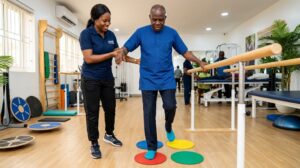
Discovering you can no longer move or walk as you used to after a stroke is debilitating.
When you sprain an ankle, it goes into a cast, and within a few weeks, you are up and about again.
A stroke is fundamentally different.
The moment a stroke happens, a sudden interruption of blood flow to the brain disrupts the communication channels between your central nervous system and the rest of your body. Depending on the area affected, it can impair speech, cognition, memory, and physical mobility.
Most notably, one side of the body often becomes severely weakened. The core issue isn’t damage to the hand, hip, or leg itself; the problem is that the brain can no longer “talk” to those parts of the body.
The Breaker Box Analogy
Think of your brain as a central electrical control panel and your body as a house.
From the breaker box, separate wires run to different rooms: the living room, kitchen, bedrooms, and restrooms. Each wire carries electrical power to perform a specific job in its designated space.
Your body operates on the exact same logic:
- The Brain: The central breaker box.
- The Nerves: The electrical wiring.
- The Limbs & Muscles: The individual rooms and appliances.
When you want to stand, your brain flips the “hip” and “leg” switches. When you want to speak, it turns on the “mouth” and “tongue” switches.
During a stroke, specific wires running from the control panel suffer sudden damage. Power is lost—not to the entire house, but to specific rooms. That is why a stroke survivor might be able to speak clearly yet remain completely unable to move their hand, hip, or leg.
The goal of gait retraining is simple: reconnect the wiring, one step at a time.
What Is Gait Retraining?
While 65% to 85% of stroke survivors relearn to walk independently after six months, abnormal gait quality persists through the chronic stages of the condition. Many struggle to complete basic functional tests, such as walking independently for six minutes (the 6-Minute Walk Test, or 6MWT).
Gait training is a targeted form of physical therapy designed to rebuild your ability to stand, stride, and maintain dynamic balance without falling. Regaining safe mobility is often the single most important milestone in a survivor’s rehabilitation journey.
Gait dysfunction affects an estimated 80% of stroke survivors, and 30–40% still have limited or no walking ability even after completing standard rehabilitation. These stem from three main issues:
- Muscle weakness in the lower body.
- Loss of motor control and neural coordination between the brain and limbs.
- Impaired balance, leading to unsteadiness and fear of falling.
Effective gait training places real physical demands on your body. Physiotherapists push you to move against gravity rather than relying solely on passive exercises. This structured work targets real-world mobility: stepping, turning, maintaining equilibrium, and navigating obstacles.
Activating Neuroplasticity
High-intensity physical activity triggers the release of key growth factors that stimulate neural repair.
This process activates neuroplasticity—the brain’s remarkable ability to reorganize itself, forge new neural pathways, and bypass damaged areas. Think of neuroplasticity as giving your brain’s internal wiring a targeted system reboot, establishing fresh pathways to command movement.
While critical for stroke recovery, gait retraining is also essential for patients recovering from major orthopedic surgeries (such as total hip or knee replacements), spinal cord injuries, and amputations.
Key Gait Retraining Exercises
- Lower Body Strength Building
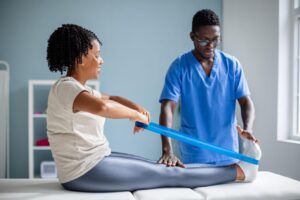
Squats
- Set up: Stand with your feet hip-width apart and extend your arms straight out in front for balance. (Hold onto the back of a sturdy chair if needed.)
- Movement: Push your hips back and bend your knees as if sitting down into an imaginary chair. Push firmly through your heels to stand tall again.
- Volume: Perform 10 controlled repetitions.
Stair Step-Ups
- Setup: Stand directly facing the bottom step of a staircase.
- Movement: Step up with your right foot, then bring your left foot up beside it. Step back down with your left foot first, followed by your right foot to return to the floor.
- Volume: Perform 10 repetitions starting with the right foot, then switch to 10 repetitions leading with the left foot.
- Obstacle & Spatial Training
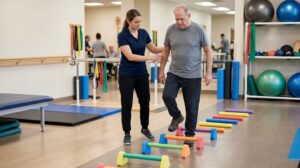
Obstacle training improves motor control and foot clearance while stepping over physical objects.
- Setup: Place small, safe obstacles (such as low blocks or rolled towels) roughly 15 to 20 inches apart in a straight line.
- Movement: Stand facing the first obstacle. Step over it cleanly with your leading foot, bringing your trailing foot to join it. Continue down the line. Turn around and lead with the opposite foot on the return path.
- Volume: Perform 10 full passes per leg.
- Range of Motion (ROM) & Flexibility
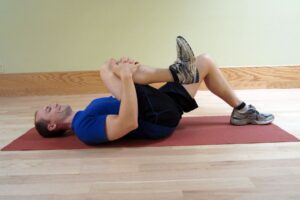
Stroke often causes muscle tightness and joint stiffness. Improving range of motion allows your limbs to swing smoothly during a stride.
- Calf Towel Stretch: Sit on the floor with your legs extended forward. Loop a towel around the ball of your right foot. Gently pull the ends of the towel back toward your torso until you feel a firm stretch in your calf. Hold for 10 seconds. Repeat on the left side.
- Ankle Pumps: Sitting or lying down, point your toes straight down toward the floor, then flex them upward toward your knees. Continue this pumping motion for 2 minutes to promote blood flow and ankle flexibility.
- Target Stepping
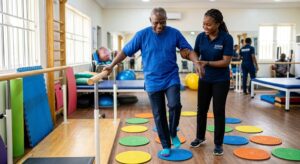
This exercise sharpens foot placement accuracy and spatial coordination.
- Setup: Arrange 4 to 5 paper plates on the ground in a semi-circle, about one foot apart.
- Movement: Stand in the center. Reach out with one foot to gently tap a target plate, then return to your starting stance. Reach out to tap a different plate.
- Volume: Complete a full sequence tapping each target with one foot, then repeat with the opposite leg.
- Retro Walking (Backward Walking)
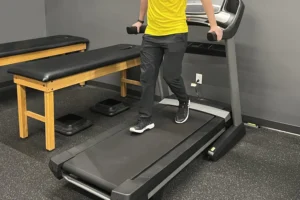
Walking backward engages different muscle activation patterns than forward walking. It reduces stress on the knee joints, improves dynamic balance, and forces the brain to pay closer attention to motor control.
How to perform retro walking:
Set a treadmill to a slow, safe walking speed (or walk along an unobstructed hallway with support nearby).
- Reach one leg backward, landing softly on your toes first.
- Roll your foot flat through the midfoot, finishing down on your heel.
- Maintain a steady rhythm, rolling toe-to-heel with every step.
Primary benefits of retro walking:
- Keeps you steady on your feet, reducing sway and fall risk.
- Keeps the muscles behind your thighs supple for smoother leg extension.
- Trains your brain and muscles to execute controlled, deliberate movements.
- Builds the functional strength needed to walk faster forward.
- Wakes up key muscles on the front of your thigh so they fire reliably when you step.